


Support for Visual Processing with Microsoft Word
By the end of this project, you will have created multiple tools to assist students in your classroom who need support for visual processing. Whether they would benefit from reading trackers or organizational supports for their work, you will become confident at how to support their needs in order to encourage their success in the classroom.
Buy Now Free

- Level Foundation
- المدة 3 ساعات hours
- الطبع بواسطة Coursera
-
Offered by

عن
By the end of this project, you will have created multiple tools to assist students in your classroom who need support for visual processing. Whether they would benefit from reading trackers or organizational supports for their work, you will become confident at how to support their needs in order to encourage their success in the classroom.الوحدات
Your Learning Journey
-
 1
Readings
1
Readings
-
 1
Plugin
1
Plugin
-
 1
Lab
1
Lab
-
 1
Assignment
1
Assignment
 1
Assignment
1
Assignment
- Assess Your Knowledge
 1
Labs
1
Labs
- Support for Visual Processing with Microsoft Word
1
Readings
- Project Overview
Auto Summary
Discover the transformative power of Microsoft Word in supporting students with visual processing needs through this engaging and practical course. Designed for educators and classroom assistants, this beginner-level course provides you with the skills to create essential tools like reading trackers and organizational aids to enhance student success. Under the expert guidance of Coursera, you will embark on a 180-minute journey to gain confidence in using Microsoft Word to address and support the unique needs of your students. Best of all, this course is available for free, making it an accessible resource for anyone looking to make a positive impact in the classroom. Join us and empower your students with the visual processing support they need to thrive.
Buy Now Free

- Level Foundation
- المدة 3 ساعات hours
-
Offered by
عن
Figma is a web-based graphics editing and user interface design app that works on your browser. What does that really mean? You can access your projects from multiple devices without installing software. You and others can work on the same file in real-time taking the project from brainstorming to prototypes. You can use Figma to design briefs, create storyboards, reduce complexity on web sites and even design your CV or resume all while collaborating with others in real time! By the end of this project, you will go through the steps to learn about the application to develop a web page or homepage for your own app.Auto Summary
"Get Started with Figma" is an engaging beginner-level course offered by Coursera, designed to introduce learners to the world of web-based graphics editing and user interface design using Figma. This course is perfect for those interested in personal development and looking to enhance their design skills. With a focus on providing practical and hands-on experience, you'll learn to navigate Figma's powerful tools and features right from your browser. The course spans approximately 180 minutes, making it a concise yet comprehensive introduction to Figma. Best of all, this course is available for free, making it an accessible option for anyone eager to start their design journey. Whether you're a complete novice or looking to brush up on your design skills, "Get Started with Figma" is your gateway to mastering this versatile design platform.

Network Dynamics of Social Behavior
How do revolutions emerge without anyone expecting them? How did social norms about same sex marriage change more rapidly than anyone anticipated? Why do some social innovations take off with relative ease, while others struggle for years without spreading? More generally, what are the forces that control the process of social evolution –from the fashions that we wear, to our beliefs about religious tolerance, to our ideas about the process of scientific discovery and the best ways to manage complex research organizations? The social world is complex and full of surprises.
Monthly Subscription Starting at AED 99 + VAT

- Level Foundation
- المدة 5 ساعات hours
- الطبع بواسطة University of Pennsylvania
-
Offered by
عن
How do revolutions emerge without anyone expecting them? How did social norms about same sex marriage change more rapidly than anyone anticipated? Why do some social innovations take off with relative ease, while others struggle for years without spreading? More generally, what are the forces that control the process of social evolution –from the fashions that we wear, to our beliefs about religious tolerance, to our ideas about the process of scientific discovery and the best ways to manage complex research organizations? The social world is complex and full of surprises. Our experiences and intuitions about the social world as individuals are often quite different from the behaviors that we observe emerging in large societies. Even minor changes to the structure of a social network - changes that are unobservable to individuals within those networks - can lead to radical shifts in the spread of new ideas and behaviors through a population. These “invisible” mathematical properties of social networks have powerful implications for the ways that teams solve problems, the social norms that are likely to emerge, and even the very future of our society. This course condenses the last decade of cutting-edge research on these topics into six modules. Each module provides an in-depth look at a particular research puzzle -with a focus on agent-based models and network theories of social change -and provides an interactive computational model for you try out and to use for making your own explorations! Learning objectives - after this course, students will be able to... - explain how computer models are used to study challenging social problems - describe how networks are used to represent the structure of social relationships - show how individual actions can lead to unintended collective behaviors - provide concrete examples of how social networks can influence social change - discuss how diffusion processes can explain the growth social movements, changes in cultural norms, and the success of team problem solvingالوحدات
Introduction
-
 1
Videos
1
Videos
1
Videos
- 1.0 Course Introduction and Objectives
Thomas Schelling’s Segregation Model
-
6
Videos
6
Videos
- 1.1 The Substantive Problem: Micromotives and Macrobehavior
- 1.2 What are Agent-Based Models?
- 1.3 Formal Model of Segregation
- 1.4 Exploring Schelling's Segregation Model
- 1.5 How to Download and Use NetLogo
- 1.6 Using NetLogo: Schelling's Segregation Model
Quiz: Week 1
-
1
Assignment
1
Assignment
- Week 1
Network Science
-
4
Videos
4
Videos
- 2.1 Network Science: Mapping a Connected World
- 2.2 Introduction to Network Science
- 2.3 Types of Networks: Lattice Graph
- 2.4 Types of Networks: Random Graph
NetLogo
-
2
Videos
2
Videos
- 2.5 Using NetLogo: Properties of the Small World Network
- 2.6 Using NetLogo: Information Diffusion in Small World Networks
Conclusion
-
1
Videos
1
Videos
- 2.7 Conclusions: Life in a Small World
Quiz: Week 2
-
1
Assignment
1
Assignment
- Week 2
Social Contagions
-
6
Videos
6
Videos
- 3.1 Social Contagions: Beyond Information Diffusion
- 3.2 From Simple to Complex Contagions
- 3.3 How to Model Complex Contagions
- 3.4 Threshold Models in Networks
- 3.5 Using NetLogo: Complex Contagions in Small World Networks
- 3.6 Conclusion: The Spread of Behavior in a Complex World
Week 3 Quiz
-
1
Assignment
1
Assignment
- Week 3
The Emperor's Dilemma and The Spread of Unpopular Norms
-
6
Videos
6
Videos
- 4.1 The Emperor's Dilemma: Explaining Unpopular Norms
- 4.2 Components of a Norm: Compliance and Enforcement
- 4.3 Modeling Compliance and Enforcement
- 4.4 Using NetLogo: Explaining the Spread of Unpopular Norms
- 4.5 Falsification and Sufficiency in the Emperor's Dilemma
- 4.6 Self-Reinforcing Norms: A Cautionary Conclusion
Week 4 Quiz
-
1
Assignment
1
Assignment
- Week 4
The Spontaneous Emergence of Conventions
-
5
Videos
-
1
Readings
5
Videos
- 5.1 A Startup Problem: The Emergence of Norms
- 5.2 Conventions and the Challenge of Coordination
- 5.3 Modelling Pairwise Coordination in Networks
- 5.4 Using NetLogo: Coordination in Networks
- 5.5 How do norms emerge? Global Agreement from Peer-to-Peer Interation
1
Readings
- Optional Reading: Creating Critical Mass
Week 5 Quiz
-
1
Assignment
1
Assignment
- Week 5
Networks of Innovation
-
7
Videos
7
Videos
- 6.1 Exploration and Exploitation: Networks of Innovation
- 6.2 Modeling Complex Problems
- 6.3 Modeling Problem-Solving in Teams
- 6.4 Thinking about Models: Problem-Solving in the Real World
- 6.5 Using NetLogo: Complex Problem Solving in Networks
- 6.6 Conclusions: The Two Pizza Rule
- 6.7 Course Conclusions: The Network Dynamics of Social Behavior
Week 6 Quiz
-
1
Assignment
1
Assignment
- Week 6
Auto Summary
Explore the fascinating "Network Dynamics of Social Behavior" course in Personal Development, presented by Coursera. Delve into the forces driving social evolution, from cultural shifts to scientific discovery. Instructor-led and rich with agent-based models, this foundational course spans six modules over 300 minutes. Ideal for those curious about social change, it offers interactive computational models and insights into the invisible properties of social networks. Available through Starter and Professional subscriptions, this course empowers learners to understand and influence social dynamics. Perfect for anyone interested in the complexities of social behavior and change.
Mycelium Growth with NetLogo Web
Underneath our feet, spreading across the globe, a magnificent being resides. As a living network, it breaks down compounds from minerals and dead plants and animals in the soil (and pollutants as well), only to distribute these nutrients to other living organisms. Therefore, providing the cyclical nature characteristic of Nature. When conditions are right, some of these organisms will fruit into beautiful mushrooms, some of which are incredibly nutritious and with miraculous medicinal properties.
Buy Now Free
- Level Professional
- المدة 3 ساعات hours
- الطبع بواسطة Coursera
-
Offered by
عن
Underneath our feet, spreading across the globe, a magnificent being resides. As a living network, it breaks down compounds from minerals and dead plants and animals in the soil (and pollutants as well), only to distribute these nutrients to other living organisms. Therefore, providing the cyclical nature characteristic of Nature. When conditions are right, some of these organisms will fruit into beautiful mushrooms, some of which are incredibly nutritious and with miraculous medicinal properties. The organism described is the Mycelium, or the vegetative part of a fungus organism. In this project we will create an agent based model that simulates possible mechanisms through which fungi mycelium grows, as observed through microscopic lenses. For that we will be working with NetLogo Web, a very powerful online modeling environment. Learns will be introduced to this environment, as well as the basics of the Logo programming language. Note: This project works best for learners who are based in the North America region. We’re currently working on providing the same experience in other regions.الوحدات
Practical Application via Rhyme
-
1
Readings
-
1
Plugin
-
1
Lab
-
1
Assignment
1
Assignment
- Graded Quiz: Test your Project understanding
1
Labs
- Hands-on Project
1
Readings
- Course Overview
Auto Summary
Discover the fascinating world of mycelium in the "Mycelium Growth with NetLogo Web" course. This professional-level program dives into the growth mechanisms of fungi mycelium using the NetLogo Web modeling environment. Ideal for learners in North America, this 120-hour course introduces the basics of the Logo programming language. Offered by Coursera, it provides a starter subscription option. Perfect for those interested in personal development and the intricate relationships within nature.

Learn to Teach Java: Inheritance and Recursion
Learn to program with Inheritance and Recursion in Java, and prepare to teach others using the free, online interactive CS Awesome textbook. In this course for teachers we'll guide you both in learning Java concepts and skills but also in how to effectively teach those to your students. This course will support you in teaching the Advanced Placement Computer Science A course or a similar introductory university-level programming course. We'll cover the Java concepts of inheritance and recursion, as covered in the APCS A Units 9 and 10.
Monthly Subscription Starting at AED 99 + VAT

- Level Foundation
- المدة 11 ساعات hours
- الطبع بواسطة University of California San Diego
-
Offered by
عن
Learn to program with Inheritance and Recursion in Java, and prepare to teach others using the free, online interactive CS Awesome textbook. In this course for teachers we'll guide you both in learning Java concepts and skills but also in how to effectively teach those to your students. This course will support you in teaching the Advanced Placement Computer Science A course or a similar introductory university-level programming course. We'll cover the Java concepts of inheritance and recursion, as covered in the APCS A Units 9 and 10. Each topic will begin by relating Java to block-based programming languages and then provide video overviews of CS Awesome content along with additional materials to supplement learning for your students. You'll engage with additional materials to support your teaching including "deep dive" classroom discussion questions, assessment overviews, code tracing and problem solving skills for your students, including preparation for free response coding questions.الوحدات
Welcome
-
2
Videos
-
1
Discussion
1
Discussions
- Meet your fellow learners!
2
Videos
- Welcome!
- Welcome to the Learn to Teach Java Specialization
Technology Prepararion
-
2
Readings
2
Readings
- Make an Account on these Sites
- Using Googledocs in this Course
Guided Textbook Learning Part 1
-
7
Videos
-
3
Assignment
3
Assignment
- CS Awesome 9.1
- CS Awesome 9.2, 9.3 and 9.4
- CS Awesome 9.5
7
Videos
- Inheritance Part 1
- Inheritance Part 2
- Inheritance and Constructors
- Overriding Methods
- super keyword
- Inheritance Hierarchies Part 1
- Inheritance Hierarchies Part 2
Guided Textbook Learning Part 2
-
4
Videos
-
2
Assignment
2
Assignment
- CS Awesome 9.6
- CS Awesome 9.7
4
Videos
- Polymorphism Part 1
- Polymorphism Part 2
- Object Superclass Part 1
- Object Superclass Part 2
Culturally Relevant Inheritance Examples
-
1
Readings
-
1
Discussion
1
Discussions
- New Discussion Prompt
1
Readings
- What is Culturally Relevant Pedagogy/Teaching
Teacher Powerup
-
3
Videos
3
Videos
- Assessment Options
- Trio Free Response Question Overview Part 1
- Trio Free Response Question Overview Part 2
Mastery Quiz
-
2
Assignment
2
Assignment
- Java Mastery Quiz
- Teacher Mastery Quiz
From Block to Text
-
1
Readings
1
Readings
- Explore Recursion with Fractals
Guided Textbook Learning
-
7
Videos
-
2
Assignment
2
Assignment
- CS Awesome 10.1
- CS Awesome 10.2
7
Videos
- Recursion Part 1
- Recursion Part 2
- Tracing Recursive Methods Part 1
- Tracing Recursive Methods Part 2
- Tracing Recursive Methods Part 3
- Recursive Searching and Sorting Part 1
- Recursive Searching and Sorting Part 2
Classroom Discussions
-
1
Videos
-
 1
ExternalTool
1
ExternalTool
1
External Tool
- Classroom Discussions: Recursion
1
Videos
- Classroom Discussions: Teacher Guide
Teacher Powerup
-
2
Videos
2
Videos
- Assessment Options
- Developing Problem Solving Skills
Mastery Quiz
-
2
Assignment
2
Assignment
- Java Mastery Quiz
- Teacher Mastery Quiz
Auto Summary
Discover "Learn to Teach Java: Inheritance and Recursion," a foundational course designed for educators aiming to master and teach Java concepts. Focused on inheritance and recursion, this course utilizes the interactive CS Awesome textbook to enhance your programming skills and teaching methods. Ideal for those instructing Advanced Placement Computer Science A or introductory university-level courses, it includes video overviews, supplemental materials, and classroom resources. Offered by Coursera, with a duration of 660 minutes, flexible subscription options are available. Perfect for educators seeking to elevate their teaching strategies in Java programming.
Create an Employee Feedback Survey with TypeForm
Typeform is an online SaaS company that specializes in dynamic form building and online surveys. Typeform is used by large corporations and small businesses for a variety of different business operations. You will see Typeform used in analytics & reporting, collaboration, customer support, email marketing, lead generation, and so much more. Typeform works in conjunction with several well-known apps to seamlessly inegrate into your marketing & sales environment.
Buy Now Free

- Level Foundation
- المدة 3 ساعات hours
- الطبع بواسطة Coursera
-
Offered by
عن
Typeform is an online SaaS company that specializes in dynamic form building and online surveys. Typeform is used by large corporations and small businesses for a variety of different business operations. You will see Typeform used in analytics & reporting, collaboration, customer support, email marketing, lead generation, and so much more. Typeform works in conjunction with several well-known apps to seamlessly inegrate into your marketing & sales environment. By integrating Typeform into apps you’re currently using you will expand your business’ capacity for growth. This project is an introductory level course intended for business professionals who would like to collect employee feedback using interactive forms. The project will focus on the basics of creating an interactive form. We will learn about the different types of questions available, themes. and sharing our survey. At the end of the project the learner will be able to design their own professional dynamic form for collecting employee feedback. This project will talk briefly about sharing the survey with respondents. The focus of this project is helping learners to begin the process by familiarizing them with the platform and creating the survey using features available in the free version. Typeform values its user’s security and understands the need for rigorous security measures. Their infrastructure is hosted via Amazon Web Services (AWS) on servers located in Virginia and Frankfurt, Germany. You can view Typeform’s full security policy here: https://help.typeform.com/hc/en-us/articles/360029259552-Security-at-Typeformالوحدات
Creating an Employee Feedback Survey with Typeform
-
1
Readings
-
1
Plugin
-
1
Lab
-
1
Assignment
1
Assignment
- Graded Quiz: Test your Project understanding
1
Labs
- Creating an Employee Feedback Survey with Typeform
1
Readings
- Project-based Course Overview
Auto Summary
Discover how to create an employee feedback survey using TypeForm in this beginner-friendly course. Ideal for business professionals, you'll learn to design interactive forms, explore different question types, and share your survey. Taught by Coursera, this 3-hour course leverages TypeForm's free version and integrates seamlessly with your existing tools, promoting business growth. Join for free and start enhancing your feedback collection skills today!
Monthly Subscription Starting at AED 99 + VAT

- Level Foundation
- المدة 11 ساعات hours
- الطبع بواسطة Technical University of Munich (TUM)
-
Offered by
عن
Would you like to spend some time of your study experience or even your whole study course abroad? Did you hear about the top universities in Germany? Then "Welcome to Munich"! In the first modules of this course we will show you, why Munich and its universities - especially the Technical University of Munich - will be a rewarding choice for you while making your dream of studying abroad come true. In the next modules you will learn what you have to do before coming here and how to get started at the university once you've arrived. And last but not least, we will provide you with tips and information about how to find your study-life-balance in Munich and the surrounding areas. What are you waiting for? Start this course now and we will see you soon in Munich!الوحدات
Welcome to Munich
-
1
Videos
-
2
Readings
1
Videos
- Get to know the MOOC
2
Readings
- Introductory reading
- Course updates
Learner Connections
-
1
Discussion
1
Discussions
- Introduce yourself!
Introduction
-
1
Videos
-
2
Readings
1
Videos
- Final: Introduction
2
Readings
- Guiding questions
- Optional: Links to get to know the city
Reasons for coming to Munich
-
1
Videos
-
1
Readings
1
Videos
- 10 Reasons why Munich is a great city to study
1
Readings
- Facts and figures: Bavaria and Munich
Universities in Munich
-
2
Readings
2
Readings
- Facts and Figures: the biggest Universities in Munich at a glance
- Getting to know the universities - important links
Student voices
-
1
Videos
-
1
Readings
1
Videos
- Why did you choose Munich?
1
Readings
- Student survey results
Discussion
-
1
Discussion
1
Discussions
- What do YOU think?
Introduction
-
1
Videos
-
1
Readings
1
Videos
- Introduction Video
1
Readings
- Guiding questions
Getting to know TUM
-
1
Videos
-
2
Readings
1
Videos
- TUM Overview
2
Readings
- Important Links: TUM
- Getting to know TUM
Student voices
-
1
Videos
-
1
Readings
1
Videos
- Group interview
1
Readings
- Student survey
Discussion
-
1
Discussion
1
Discussions
- First impressions about TUM
Introduction
-
1
Videos
-
1
Readings
1
Videos
- Introduction Video
1
Readings
- Guiding questions
In General
-
1
Videos
-
1
Readings
-
1
Assignment
1
Assignment
- One quick Quiz-Question
1
Videos
- CST - General student advising
1
Readings
- General Information
Information for Exchange Students
-
1
Readings
-
1
Assignment
1
Assignment
- True or false?
1
Readings
- What you need to know
Information for degree seeking students
-
1
Readings
-
1
Assignment
1
Assignment
- Who's your contact?
1
Readings
- What you need to know
Learning German
-
1
Videos
-
1
Readings
1
Videos
- Learning German
1
Readings
- German courses online
Finding accommodation
-
1
Videos
-
2
Readings
-
1
Assignment
1
Assignment
- Test your knowledge on Finding Accommodation
1
Videos
- Students' experience
2
Readings
- Living in Munich
- FAQs: Accommodation
Costs of living
-
1
Readings
-
1
Assignment
1
Assignment
- What do you estimate?
1
Readings
- Living expenses
Discussion
-
1
Discussion
1
Discussions
- Challenges
Introduction
-
1
Videos
-
1
Readings
1
Videos
- Introduction
1
Readings
- Guiding questions
Bureaucracy
-
1
Readings
1
Readings
- What you need to do after your arrival - a checklist for the basics
Explore a new city
-
2
Readings
-
1
Assignment
1
Assignment
- Do you know your way around Munich?
2
Readings
- Explore a new City_Transport
- Explore a new City - Neighbourhoods
Explore a new culture
-
3
Videos
-
1
Readings
-
1
Assignment
1
Assignment
- Thoughts on Culture
3
Videos
- Student voices
- Interview: Cultural standards and culture blues
- Interview: Buddy Program
1
Readings
- Tips for a good start
Timeline on what to do
-
1
Readings
1
Readings
- A quick overview for degree seeking students
Discussion
-
2
Discussion
2
Discussions
- New Beginnings
- Differences
Introduction
-
1
Videos
-
1
Readings
1
Videos
- Introduction
1
Readings
- Guiding questions
Studying in Germany
-
1
Videos
-
5
Readings
-
1
Assignment
1
Assignment
- Test your knowledge on studying in Germany
1
Videos
- Student voices: Studying in Germany
5
Readings
- German study system
- Social study skills
- Amenities for Students
- ProLehre Study tips
- Interview with TUM Grading Office
A day in the life of a student
-
2
Videos
2
Videos
- Interview Karla
- Karla´s WG Life in Munich
Orientation weeks at the beginning of each semester
-
5
Videos
-
3
Readings
-
1
Assignment
1
Assignment
- Find out what you know about orientation at TUM!
5
Videos
- TUMi Interview Bergmann
- Student Voices: orientation weeks
- Orientation weeks for exchange students
- Information for degree seeking students
- Offers for degree seeking students
3
Readings
- What are orientation weeks?
- Information for exchange students
- Information for degree seeking students
Activities during the semester
-
3
Videos
-
1
Readings
-
1
Assignment
1
Assignment
- Do you know about activities during the semester?
3
Videos
- Language Center
- Activities for international students
- Language Center
1
Readings
- Activities during the semester
Discussion
-
1
Discussion
1
Discussions
- Studying in Germany
Introduction
-
1
Videos
-
1
Readings
1
Videos
- Introduction
1
Readings
- Guiding questions
Working as an international student
-
1
Videos
-
1
Readings
-
1
Assignment
1
Assignment
- Work it!
1
Videos
- Student voices: Financing your stay
1
Readings
- Side Jobs
Activities in Munich
-
3
Videos
-
1
Readings
3
Videos
- New Video
- Oktoberfest Munich
- Christkindlmarkt
1
Readings
- Leisure activities in Munich
Activities around Munich
-
1
Readings
1
Readings
- Day Trips
Student voices
-
1
Videos
1
Videos
- Favorite places
Discussion
-
2
Discussion
2
Discussions
- Finances
- Plans
Unterrichtseinheit ohne Titel
-
1
Videos
-
1
Readings
1
Videos
- Last words from your MOOC-Team
1
Readings
- Thank you and Goodbye!
Discussion
-
1
Discussion
1
Discussions
- Feedback
Auto Summary
"Welcome to Munich" is an enriching personal development course designed to guide you through the exciting journey of studying abroad at one of Germany's top universities. This course, offered by Coursera, provides a comprehensive overview of why Munich, particularly the Technical University of Munich, is an exceptional choice for international students. The course begins by highlighting the unique benefits and opportunities available in Munich, helping you understand why it is a rewarding destination for your academic pursuits. Subsequent modules focus on practical steps to prepare for your arrival, including essential preparations before your departure and strategies for acclimating to university life once you arrive. Additionally, you will receive valuable insights and tips on achieving a balanced study-life experience in Munich and exploring its vibrant surroundings. With a total duration of 660 minutes, this foundational course is available through both Starter and Professional subscription plans, catering to a wide range of learners. It is ideal for prospective students considering or planning an international study experience in Munich. Whether you're looking to spend a semester abroad or complete your entire course of study in Germany, "Welcome to Munich" is your comprehensive guide to making the most of this transformative experience. Embark on this journey today and take the first step towards an enriching academic adventure in Munich!
Growing Great Writers with Writable
By the end of this project, you will be an expert at using Writable to run a more effective writing program. With its library of assessments, writing prompts, and countless opportunities for practice and feedback, Writable is sure to help your students flourish as proficient writers. Throughout the project, we will work together to ensure that you can confidently use Writable with your students right away. *You will need a free Google or Microsoft account for this project.
Buy Now Free

- Level Foundation
- المدة 2 ساعات hours
- الطبع بواسطة Coursera
-
Offered by
عن
By the end of this project, you will be an expert at using Writable to run a more effective writing program. With its library of assessments, writing prompts, and countless opportunities for practice and feedback, Writable is sure to help your students flourish as proficient writers. Throughout the project, we will work together to ensure that you can confidently use Writable with your students right away. *You will need a free Google or Microsoft account for this project.الوحدات
Practical Application via Rhyme
-
1
Readings
-
1
Plugin
-
1
Lab
-
1
Assignment
1
Assignment
- Graded Quiz: Growing Great Writers with Writable
1
Labs
- Growing Great Writers with Writable
1
Readings
- Growing Great Writers with Writable
Auto Summary
Discover the art of nurturing exceptional writers with the "Growing Great Writers with Writable" course, designed for educators and personal development enthusiasts. This beginner-level program, offered by Coursera, focuses on effectively utilizing the Writable platform to enhance your writing curriculum. Under the expert guidance provided, you'll explore a comprehensive library of assessments and writing prompts, enabling you to offer ample practice and valuable feedback to your students. Over a span of 120 minutes, this course equips you with the skills to confidently implement Writable in your teaching practices, ensuring your students' growth as proficient writers. You will need a free Google or Microsoft account to participate. Best of all, this transformative learning experience is available at no cost, making it an ideal opportunity for anyone eager to elevate their teaching methodologies and support student success in writing.
Buy Now Free
- Level Professional
- المدة 3 ساعات hours
-
Offered by
عن
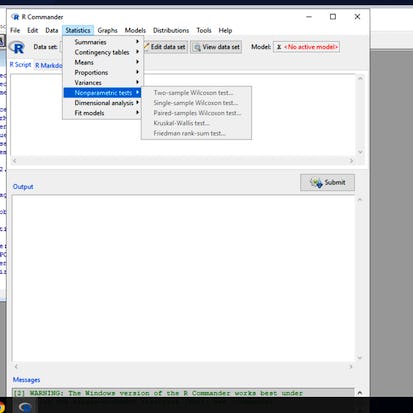
In this project , you will learn how to conduct non parametric tests using Rcmdr. Non parametric tests are powerful tests which are conducted when underlying assumptions are not met in the data . After completing the project, you will be able to apply the appropriate test for the right data set. You will also learn how to do it in an easy to use Rcmdr.Auto Summary
Unlock the potential of non-parametric tests with the "Non-parametric Tests using R Cmdr" course, designed for personal development enthusiasts and professionals seeking to enhance their data analysis skills. Guided by expert instruction from Coursera, this comprehensive course delves into the intricacies of non-parametric tests, ideal for situations where traditional assumptions about data distribution do not hold. Throughout this 120-minute course, you will master the application of various non-parametric tests using the user-friendly Rcmdr interface. Gain hands-on experience and confidently select and implement the appropriate tests for diverse data sets. Perfect for professionals aiming to deepen their statistical knowledge, this course is available through a Starter subscription, ensuring accessible and high-quality learning. Elevate your data analysis capabilities and apply these powerful techniques in your projects with ease. Join now and transform your understanding of non-parametric testing with R Cmdr.

Introduction to User Experience Design
The focus of this course is to introduce the learner to User Experience (UX) Design User Experience design is design that is user centered. The goal is to design artifacts that allow the users to meet their needs in the most effective efficient and satisfying manner. The course introduces the novice to a cycle of discovery and evaluation and a set of techniques that meet the user's needs. This course is geared toward the novice.
Monthly Subscription Starting at AED 99 + VAT

- Level Foundation
- المدة 6 ساعات hours
- الطبع بواسطة Georgia Institute of Technology
-
Offered by
عن
The focus of this course is to introduce the learner to User Experience (UX) Design User Experience design is design that is user centered. The goal is to design artifacts that allow the users to meet their needs in the most effective efficient and satisfying manner. The course introduces the novice to a cycle of discovery and evaluation and a set of techniques that meet the user's needs. This course is geared toward the novice. It is for learners that have heard about "user experience" or "user interface" design but don't really know much about these disciplines. The course mantra is that “Design is a systematic and data driven process.” Design is systematic because it is based on a set of techniques and also on a cycle of discovery. In this course the learner is introduced to the four step user interface design cycle. Along the way learners are exposed to a set of techniques to gather information about a) what the user needs b)how to design and model interfaces based on these and then how to evaluate the design to ascertain that the user's goals are met. These techniques are tools that are used in a standardized manner and give us the data we use in our design. This means that anyone (regardless of their current training) that is willing to learn these techniques and follow the proposed cycle can be a UX designer!الوحدات
Introduction and Course Overview
-
7
Readings
7
Readings
- Focus of this course
- Syllabus
- Consent Form
- 4 Step Design Process
- Outcomes
- FAQs
- Get More from Georgia Tech
Important Terms and Concepts
-
1
Videos
1
Videos
- Important Terms and Concepts
Features of Good Design
-
1
Videos
1
Videos
- Features of Good Design
User Engagement Ethics
-
1
Videos
-
1
Readings
-
1
Assignment
1
Assignment
- Overview of User Experience Design
1
Videos
- User Engagement Ethics
1
Readings
- General Resources
Elements of Requirement Gathering
-
7
Videos
-
1
Readings
7
Videos
- Overview
- Types of Users and Types ofData
- Discovery Technique Overview
- Naturalistic Observation
- Survey
- Focus Group
- Interview
1
Readings
- Resources for Requirement Gathering
Presenting the Results
-
2
Videos
-
1
Assignment
1
Assignment
- Elements of Requirement Gathering
2
Videos
- User Results
- Presenting Task Findings
Design Alternatives
-
2
Videos
-
1
Assignment
1
Assignment
- Designing Alternatives
2
Videos
- Review of Design Goals
- Design Alternatives
Prototyping
-
2
Videos
-
2
Readings
-
1
Assignment
1
Assignment
- Prototyping
2
Videos
- Prototyping: Lesson 1
- Prototyping: Lesson 2
2
Readings
- Resources and Tools for Protoyping 1
- Resources for Prototyping 2
Evaluation
-
1
Videos
-
2
Readings
-
1
Assignment
1
Assignment
- Evaluation
1
Videos
- Evaluation
2
Readings
- Resources for Evaluation
- Earn a Georgia Tech Badge/Certificate/CEUs
Auto Summary
"Introduction to User Experience Design" is a foundational course in Personal Development, designed for novices interested in User Experience (UX) and User Interface (UI) design. Led by Coursera, the course emphasizes a systematic, data-driven approach to creating user-centered designs. Over 360 minutes, learners explore a four-step design cycle and essential techniques for understanding user needs, designing interfaces, and evaluating effectiveness. Ideal for beginners, this course offers a structured pathway to becoming a proficient UX designer. Available with a Starter subscription.