


Generative AI for Business Leaders
Advertising with Meta
How Google does Machine Learning


Our Courses

CRUD Operations using MongoDB NoSQL
Unlike relational databases, NoSQL databases such as MongoDB store data as collections of fields, rather than rows and columns.
-
Course by

-
 Self Paced
-
 3 hours
-
 English

Life Cycle Assessment
This course will introduce you to Life Cycle Assessment (LCA ) methodology, a tool to assess the environmental impact of products and systems over the whole product life cycle, from cradle to grave. After a discussion of the potentials and limitations of quantitative LCA compared to other assessment tools, we will detail and practice each of the LCA phases. 1) The goals and system definition phase defines the goal and scope of the study, including the product function, functional unit, and the product system and its boundaries.
-
Course by
-
Self Paced
-
35 hours
-
English

Materials Data Sciences and Informatics
This course aims to provide a succinct overview of the emerging discipline of Materials Informatics at the intersection of materials science, computational science, and information science. Attention is drawn to specific opportunities afforded by this new field in accelerating materials development and deployment efforts. A particular emphasis is placed on materials exhibiting hierarchical internal structures spanning multiple length/structure scales and the impediments involved in establishing invertible process-structure-property (PSP) linkages for these materials.
-
Course by
-
Self Paced
-
9 hours
-
English

The Full Stack
As you prepare for your role in back-end development, practice bringing together multiple skills to build a full-stack Django app. You’ll start by setting up an environment for a local practical project, and refactoring the front and back-ends of an existing application.
-
Course by
-
Self Paced
-
25 hours
-
English
Database Structures and Management with MySQL
Develop a working knowledge of the MySQL database management system (DBMS). Gain DBMS skills such as data creation, querying and manipulation. You’ll gain further experience with SQL statements, clauses and data types.
-
Course by
-
Self Paced
-
32 hours
-
English

Learn About JSON with JavaScript
If you are relatively new to the world of cloud computing, you might have come across a term JSON and not know what it is exactly. JSON stands for JavaScript Object Notation and is widely used to exchange information between clients and servers. Many No-SQL databases also uses the format to store data. In this 1-hour long project-based course, you will learn about the format and structure of JSON, accept and process JSON in your code, and transmit JSON to other processes. No prior experience with JSON is required but basic to intermediate HTML and JavaScript is required.
-
Course by
-
Self Paced
-
2 hours
-
English
Database Creation and Modeling using MYSQL Workbench
In this 1-hour long project-based course, you will be able to identify and fully comprehend the basics of the MYSQL workbench and create a new connection to the local server. you will also learn how to create a new database and drop it, create new tables, and delete them. Moreover, You will be able to rename columns of a table, connect tables with each other, and add data to tables.
-
Course by
-
Self Paced
-
3 hours
-
English
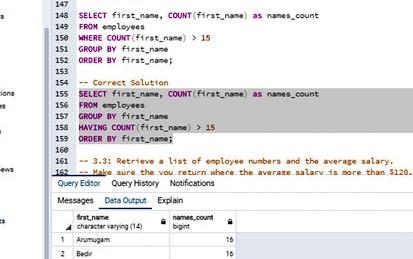
Performing Data Aggregation using SQL Aggregate Functions
In this 2-hour long project-based course, you will learn how to retrieve data from tables in a database using SQL SELECT statement with SQL Aggregate functions. The aggregate functions we will consider in this project are COUNT, SUM, MIN, MAX and AVG. Aggregate functions are used to summarize data from rows of a table into a single value. In addition, you will learn how to set conditions on the output of an aggregate function using the HAVING clause.
-
Course by
-
Self Paced
-
3 hours
-
English
Intermediate PostgreSQL
This course covers a wide range of SQL techniques, beyond basic CRUD (Create, Read, Update, and Delete) operations in PostgreSQL. You will learn the specifics of aggregation, transactions, reading and parsing CSV files and inserting data into a database. You’ll also take a look at how PostgreSQL handles and indexes text data. Specifically, students will do assignments that alter table schemas, create stored procedures, construct advanced queries, explore sorting and grouping query data, and techniques for working with text in databases including regular expressions.
-
Course by
-
16 hours
-
English
Data Manipulation and Management using MYSQL Workbench
By the end of this project, you will be able to manage data efficiently in a specific database using MYSQL Workbench. You will be able to select data from tables from your database and use keywords in select statements such as LIMIT and Top. You will be able to update the data and filter them using where statements, and also apply conditions with different ways and keywords such as like, and, or, and between.
-
Course by
-
Self Paced
-
3 hours
-
English

Database Clients
Explore how to write database driven applications in Python by creating various types of clients that connect to MySQL databases using Python code and Python-related MySQL features and tools.
-
Course by
-
Self Paced
-
40 hours
-
English

Datastream MySQL to BigQuery
This is a self-paced lab that takes place in the Google Cloud console. Learn to migrate MySQL Databases to BigQuery using Datastream and Dataflow. Datastream is a serverless and easy-to-use Change Data Capture (CDC) an…
-
Course by
-
Self Paced
-
English
Hospital management database using SQL server
In this 1-hour long project-based course, you will be able to efficiently manage databases using SQL server.
-
Course by
-
Self Paced
-
3 hours
-
English
C Tutorial
Start learning C with the W3Schools course and lay the foundations of your Programming skills. C is a general-purpose programming language, developed in 1972, and still quite popular. C is very powerful; it has been used to develop operating systems, databases, applications, etc. This is a structured and interactive version of the W3Schools C Tutorial. The course is self-paced with text based modules, practical interactive examples and exercises to check your understanding as you progress. W3schools is the world's largest web developer learning site.
-
Course by
-
Self Paced
-
11 hours
-
English
Introduction to Regular Expressions in SQL
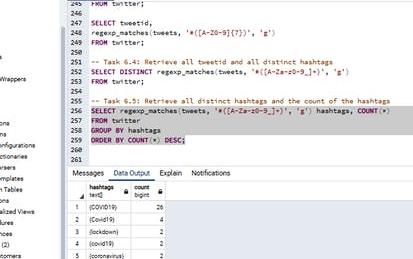
Welcome to this project-based course, Introduction to Regular Expressions in SQL. In this project, you will learn how to use SQL regular expressions extensively for pattern matching to query tables in a database. By the end of this 2-and-a-half-hour-long project, you will be able to use POSIX regular expressions together with meta (special) characters in the WHERE clause and the SELECT clause to retrieve the desired result from a database. In this project, we will move systematically by first revising the use of the LIKE and NOT LIKE operators in the WHERE clause.
-
Course by
-
Self Paced
-
3 hours
-
English

Working with Data
This course expands upon the knowledge you gained from the React Native course, and will prepare you to make more informed decisions about how you access, store, retrieve and present data within your React Native applications. The course is designed to be completed over five weeks.
-
Course by
-
Self Paced
-
21 hours
-
English
Using MySQL Database with PHP
In this 1.5 hour project, you will combine your knowledge of HTML, object-oriented PHP, SQL, and MySQL to make a dynamic website that uses MySQL database on the web server. You will learn two different methods, one applies to 12 other SQL databases and one specific to MySQL. Basic HTML, object-oriented PHP, relational database, and SQL required as prerequisites. Completing my courses "Build an Automobile Listing Website with PHP" and "Learn Object-Oriented Programming with PHP" first is highly recommended.
-
Course by
-
Self Paced
-
3 hours
-
English
SQL: A Practical Introduction for Querying Databases
Much of the world's data lives in databases. SQL (or Structured Query Language) is a powerful programming language that is used for communicating with and manipulating data in databases. A working knowledge of databases and SQL is a must for anyone who wants to start a career in Data Engineering, Data Warehousing, Data Analytics, Data Science or Business Intelligence.
-
Course by
-
Self Paced
-
21 hours
-
English
Managing Relational Databases
Students will learn about the structure and design of relational databases including primary and foreign key fields, one-to-many and one-to-one relationships. Students will learn about the Structured Query Language (SQL) and use SQL to examine the database structure. They will also learn to create and manage databases, tables, and records. The focus of the course is on data analysis. Students will start with basic SQL queries then learn to add conditional statements, and logical, comparison and arithmetic operators.
-
Course by
-
Self Paced
-
18 hours
-
English

Microsoft Azure SQL
In this course, you will learn the fundamentals of database concepts in a cloud environment, get basic skilling in cloud data services, and build your foundational knowledge of cloud data services within Microsoft Azure. You will explore relational data offerings, provisioning and deploying relational databases, and querying relational data through cloud data solutions with Microsoft Azure.
-
Course by
-
Self Paced
-
7 hours
-
English

AWS DynamoDB Fundamentals
Amazon DynamoDB Fundamentals is a skill enhancement course designed for candidates aiming to enhance their knowledge as Database professionals. This course will help learners understand working with NoSQL databases. Furthermore, fluency in basic concepts of AWS DynamoDB brings long-term opportunities with a specialization in database designing on the cloud. This course provides 7+ hours of training videos which are segmented into modules. The course concepts are easy to understand through lab demonstrations.
-
Course by
-
Self Paced
-
19 hours
-
English

Network Security & Database Vulnerabilities
This course gives you the background needed to understand basic network security. You will learn the about Local Area Networks, TCP/IP, the OSI Framework and routing basics. You will learn how networking affects security systems within an organization. You will learn the network components that guard an organization from cybersecurity attacks.\n\nIn addition to networking, you will learn about database vulnerabilities and the tools/knowledge needed to research a database vulnerability for a variety of databases including SQL Injection, Oracle, Mongo and Couch.
-
Course by
-
Self Paced
-
15 hours
-
English

Prepare Data for Exploration
This is the third course in the Google Data Analytics Certificate. As you continue to build on your understanding of the topics from the first two courses, you’ll be introduced to new topics that will help you gain practical data analytics skills. You’ll learn how to use tools like spreadsheets and SQL to extract and make use of the right data for your objectives, and how to organize and protect your data.
-
Course by
-
26 hours
-
English

Relational database systems
Welcome to the specialization course Relational Database Systems. This course will be completed on six weeks, it will be supported with videos and various documents that will allow you to learn in a very simple way how several types of information systems and databases are available to solve different problems and needs of the companies.
-
Course by
-
Self Paced
-
15 hours
-
English

Bioinformatic Methods I
Large-scale biology projects such as the sequencing of the human genome and gene expression surveys using RNA-seq, microarrays and other technologies have created a wealth of data for biologists. However, the challenge facing scientists is analyzing and even accessing these data to extract useful information pertaining to the system being studied. This course focuses on employing existing bioinformatic resources – mainly web-based programs and databases – to access the wealth of data to answer questions relevant to the average biologist, and is highly hands-on.
-
Course by
-
Self Paced
-
20 hours
-
English