


Generative AI for Business Leaders
Advertising with Meta
How Google does Machine Learning


Our Courses

Optimización de Redes Neuronales Profundas
Este curso se centrará en la optimización de Redes Neuronales Profundas, cambiando la idea de que todo el proceso es una “caja negra”. Comprenderá qué impulsa el rendimiento y podrá obtener mejores resultados de manera más sistemática Entenderá cómo optimizar los principales Hiperparámetros y su implementación. Además, aprenderá nuevos conceptos útiles para el entrenamiento de las redes como los mini-batch y las regularizaciones. También, aprenderá a implementar una red neuronal utilizando TensorFlow
-
Course by

-
 Self Paced
-
 Spanish

Activity Recognition using Python, Tensorflow and Keras
Note: The rhyme platform currently does not support webcams, so this is not a live project.
-
Course by
-
Self Paced
-
 2 hours
-
English
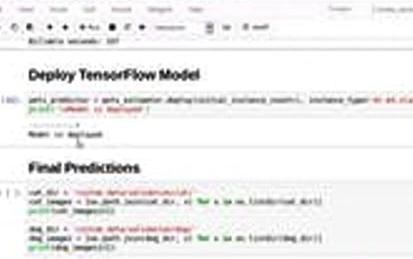
AutoML avec AutoKeras - Classification d'images
Dans ce projet guidé, vous créerez des modèles de Deep Learning (Apprentissage profond) automatisés facilement en utilisant AutoKeras une bibliothèque basée sur Keras et Tensorflow.
-
Course by
-
Self Paced
-
3 hours
-
French

CNNs with TensorFlow: Basics of Machine Learning
In this 90-min long project-based course you will learn how to use Tensorflow to construct neural network models. Specifically, we will design, execute, and evaluate a neural network model to help a retail company with their marketing campaign by classifying images of clothing items into 10 different categories. Throughout this course, you will learn how to use Tensorflow to build and analyze neural neural networks that can perform multi-label classification for applications in image recognition.
-
Course by
-
Self Paced
-
3 hours
-
English

Clasificación de imágenes con Tensorflow
En este proyecto de 1 hora, aprenderás a usar Tensorflow para desarrollar tu primera red neuronal, usango Google Colaboratory para ello.
-
Course by
-
Self Paced
-
1 hour
-
Spanish

Data Balancing with Gen AI: Credit Card Fraud Detection
In this 2-hour guided project, you will learn how to leverage Generative AI for data generation to address data imbalance. SecureTrust Financial Services, a financial institution, has asked us to help them improve the accuracy of their fraud detection system. The model is a binary classifier, but it's not performing well due to data imbalance. As data scientists, we will employ Generative Adversarial Networks (GANs), a subset of Generative AI, to create synthetic fraudulent transactions that closely resemble real transactions.
-
Course by
-
Self Paced
-
3 hours
-
English

TensorFlow on Google Cloud
This course covers building ML models with TensorFlow and Keras, improving the accuracy of ML models and writing ML models for scaled use.
-
Course by
-
Self Paced
-
13 hours
-
English
Production Machine Learning Systems
In this course, we dive into the components and best practices of building high-performing ML systems in production environments. We cover some of the most common considerations behind building these systems, e.g. static training, dynamic training, static inference, dynamic inference, distributed TensorFlow, and TPUs. This course is devoted to exploring the characteristics that make for a good ML system beyond its ability to make good predictions.
-
Course by
-
Self Paced
-
19 hours
-
English

Browser-based Models with TensorFlow.js
Bringing a machine learning model into the real world involves a lot more than just modeling. This Specialization will teach you how to navigate various deployment scenarios and use data more effectively to train your model. In this first course, you’ll train and run machine learning models in any browser using TensorFlow.js. You’ll learn techniques for handling data in the browser, and at the end you’ll build a computer vision project that recognizes and classifies objects from a webcam. This Specialization builds upon our TensorFlow in Practice Specialization.
-
Course by
-
Self Paced
-
19 hours
-
English
Natural Language Processing with Attention Models
In Course 4 of the Natural Language Processing Specialization, you will: a) Translate complete English sentences into Portuguese using an encoder-decoder attention model, b) Build a Transformer model to summarize text, c) Use T5 and BERT models to perform question-answering. By the end of this Specialization, you will have designed NLP applications that perform question-answering and sentiment analysis, and created tools to translate languages and summarize text! Learners should have a working knowledge of machine learning, intermediate Python including experience with a deep learning fra
-
Course by
-
Self Paced
-
35 hours
-
English
Data Pipelines with TensorFlow Data Services
Bringing a machine learning model into the real world involves a lot more than just modeling.
-
Course by
-
Self Paced
-
12 hours
-
English

Customising your models with TensorFlow 2
Welcome to this course on Customising your models with TensorFlow 2! In this course you will deepen your knowledge and skills with TensorFlow, in order to develop fully customised deep learning models and workflows for any application. You will use lower level APIs in TensorFlow to develop complex model architectures, fully customised layers, and a flexible data workflow.
-
Course by
-
27 hours
-
English

Machine Learning for All
Machine Learning, often called Artificial Intelligence or AI, is one of the most exciting areas of technology at the moment. We see daily news stories that herald new breakthroughs in facial recognition technology, self driving cars or computers that can have a conversation just like a real person. Machine Learning technology is set to revolutionise almost any area of human life and work, and so will affect all our lives, and so you are likely to want to find out more about it.
-
Course by
-
Self Paced
-
22 hours
-
English

Probabilistic Deep Learning with TensorFlow 2
Welcome to this course on Probabilistic Deep Learning with TensorFlow! This course builds on the foundational concepts and skills for TensorFlow taught in the first two courses in this specialisation, and focuses on the probabilistic approach to deep learning. This is an increasingly important area of deep learning that aims to quantify the noise and uncertainty that is often present in real world datasets.
-
Course by
-
Self Paced
-
53 hours
-
English
Natural Language Processing with Classification and Vector Spaces
In Course 1 of the Natural Language Processing Specialization, you will: a) Perform sentiment analysis of tweets using logistic regression and then naïve Bayes, b) Use vector space models to discover relationships between words and use PCA to reduce the dimensionality of the vector space and visualize those relationships, and c) Write a simple English to French translation algorithm using pre-computed word embeddings and locality-sensitive hashing to relate words via approximate k-nearest neighbor search.
-
Course by
-
Self Paced
-
33 hours
-
English
Introduction to TensorFlow for Artificial Intelligence, Machine Learning, and Deep Learning
If you are a software developer who wants to build scalable AI-powered algorithms, you need to understand how to use the tools to build them. This course is part of the DeepLearning.AI TensorFlow Developer Specialization and will teach you best practices for using TensorFlow, a popular open-source framework for machine learning. The Machine Learning course and Deep Learning Specialization from Andrew Ng teach the most important and foundational principles of Machine Learning and Deep Learning.
-
Course by
-
Self Paced
-
18 hours
-
English
Custom Models, Layers, and Loss Functions with TensorFlow
In this course, you will: • Compare Functional and Sequential APIs, discover new models you can build with the Functional API, and build a model that produces multiple outputs including a Siamese network. • Build custom loss functions (including the contrastive loss function used in a Siamese network) in order to measure how well a model is doing and help your neural network learn from training data.
-
Course by
-
Self Paced
-
31 hours
-
English

Getting started with TensorFlow 2
Welcome to this course on Getting started with TensorFlow 2! In this course you will learn a complete end-to-end workflow for developing deep learning models with Tensorflow, from building, training, evaluating and predicting with models using the Sequential API, validating your models and including regularisation, implementing callbacks, and saving and loading models. You will put concepts that you learn about into practice straight away in practical, hands-on coding tutorials, which you will be guided through by a graduate teaching assistant.
-
Course by
-
Self Paced
-
26 hours
-
English

Natural Language Processing in TensorFlow
If you are a software developer who wants to build scalable AI-powered algorithms, you need to understand how to use the tools to build them. This Specialization will teach you best practices for using TensorFlow, a popular open-source framework for machine learning. In Course 3 of the DeepLearning.AI TensorFlow Developer Specialization, you will build natural language processing systems using TensorFlow. You will learn to process text, including tokenizing and representing sentences as vectors, so that they can be input to a neural network.
-
Course by
-
Self Paced
-
24 hours
-
English

Improving Deep Neural Networks: Hyperparameter Tuning, Regularization and Optimization
In the second course of the Deep Learning Specialization, you will open the deep learning black box to understand the processes that drive performance and generate good results systematically.
-
Course by
-
Self Paced
-
24 hours
-
English

Sequences, Time Series and Prediction
If you are a software developer who wants to build scalable AI-powered algorithms, you need to understand how to use the tools to build them. This Specialization will teach you best practices for using TensorFlow, a popular open-source framework for machine learning. In this fourth course, you will learn how to build time series models in TensorFlow. You’ll first implement best practices to prepare time series data. You’ll also explore how RNNs and 1D ConvNets can be used for prediction.
-
Course by
-
Self Paced
-
23 hours
-
English
Feature Engineering
This course explores the benefits of using Vertex AI Feature Store, how to improve the accuracy of ML models, and how to find which data columns make the most useful features. This course also includes content and labs on feature engineering using BigQuery ML, Keras, and TensorFlow.
-
Course by
-
Self Paced
-
8 hours
-
English
Convolutional Neural Networks in TensorFlow
If you are a software developer who wants to build scalable AI-powered algorithms, you need to understand how to use the tools to build them. This course is part of the DeepLearning.AI TensorFlow Developer Specialization and will teach you best practices for using TensorFlow, a popular open-source framework for machine learning. In Course 2 of the DeepLearning.AI TensorFlow Developer Specialization, you will learn advanced techniques to improve the computer vision model you built in Course 1.
-
Course by
-
Self Paced
-
17 hours
-
English

Natural Language Processing with Probabilistic Models
In Course 2 of the Natural Language Processing Specialization, you will: a) Create a simple auto-correct algorithm using minimum edit distance and dynamic programming, b) Apply the Viterbi Algorithm for part-of-speech (POS) tagging, which is vital for computational linguistics, c) Write a better auto-complete algorithm using an N-gram language model, and d) Write your own Word2Vec model that uses a neural network to compute word embeddings using a continuous bag-of-words model. By the end of this Specialization, you will have designed NLP applications that perform question-answering and se
-
Course by
-
Self Paced
-
31 hours
-
English

Natural Language Processing on Google Cloud
This course introduces the products and solutions to solve NLP problems on Google Cloud.
-
Course by
-
Self Paced
-
13 hours
-
English